Monday, July 20, 2009

Matter of Interpretation

Although there exists a multiplicity of interpretations for every passage of the Bible, some are considered acceptable within mainstream Judaism, and some are decidedly "outside the pale." Thus, when Orthodox Jews talk about "Torah," they mean not so much the literal Five Books of Moses as they do the corpus of Jewish scripture as understood by the traditional Rabbinic sources, or at least, in a way not openly conflicting with them. For example, someone who reads the following passage:

When men strive together one with another, and the wife of the one draweth near for to deliver her husband out of the hand of him that smiteth him, and putteth forth her hand, and taketh him by the secrets: Then thou shalt cut off her hand, thine eye shall not pity her.

-Deuteronomy 25:11-12 (King James Version)

and concludes that it means what it says, would be shunned as a heretic (as the Sadducees were).

Conversely, doubting that adultery should be punished by stoning, as in Deuteronomy 22

23 If a man happens to meet in a town a virgin pledged to be married and he sleeps with her, 24 you shall take both of them to the gate of that town and stone them to death—the girl because she was in a town and did not scream for help, and the man because he violated another man's wife. You must purge the evil from among you.

would likely be lumped together with the Christians


Sunday, February 1, 2009

Fish or Fowl

One of the most conspicuous aspects of the Kosher rules is the prohibition against mixing meat and milk. The source is a single cryptic statement, repeated three times in the Torah -
"Don't cook a kid (goat) in its mothers milk" (Exodus 3:19 and 34:26, Deuteronomy 14:21). The modern understanding is to forbid the Israelites from emulating the ancient pagan fertility ritual that consisted of literally boiling a kid goat in it's own mother's milk. This may be compared to other specific injunctions against local superstitions, for example, the necromancy of "ov and yedoni" et cetera. Of course, if this was the extent of the prohabition as it was practiced today, it would hardly be noticible at all, since few contemperary farmers (at least, in Western countries) are trying increase thier crop yields with animal sacrifice. However, today's Orthodox Jews scrupulously avoid cheeseburgers, own at least two complete sets of dishes, and partronize separate resturants for meat and milk. So how did this happen?

First of all, the Torah prohabition was intrepreted much more broadly by the Talmudic Rabbis:
*Not only a "kid," that is, a young goat or sheep, but any mammal
*Not just it's mother's milk, but the milk of any animal (even of another species)
*Not just for ritual purposes, but for any reason
*Written three times means "Don't cook it, Don't eat it if they were cooked together , Don't benefit from it" (Notice that these are not disjoint catagories!)

So far, this was taken by traditional commentators to be the "original meaning" of the verse. During the Talmudic period, a large number of additonal "Fences" were added as Rabbic Enactments:

*Not only mammals, but even fowl (which don't give milk)
*Any mixture of milk and meat, even if not cooked at all
*Must have separate pots, dishes, and utensils for milk and meat
*Must wait some time period (1,3,5, or 6 hours) after eating meat before eating milk

So a large part of the Kosher rules are based enitrely on one statement, its expansive interpretation, and hugely expansive added safeguards, when a simple reading seems to imply that one one particular pagan practice was to be outlawed.

Why did this happen? Why so many protections for one rule, compared to almost any other commandment? This may relate to the whole point of food taboos in general, an enforced separation from other groups. Sociallizing with outsiders is severely limited if eating together is not possible. This is explicitly stated when it comes to enactments like Bishuil Achum and Stam Yanam, and the result is the same for other Kosher rules).
Another explanation for why it seemed plausible to have so many safeguards is that avoiding "tainted" or even questionable food is very adaptive from an evolutionary perspective, so humans are automatically conscious of the possibility of contamination.

For more see wikipedia article

Friday, November 21, 2008

Splitting Doublets

Like many Jewish day school students, my formal instruction in the Pentateuch began in third grade with Genesis 12. I still remember our class in which we started with G-d's command to Abraham (then called Abram), "Lech Lecha," to leave his homeland and go to the land of Canaan, making him the first patriarch of the chosen people. Even at a young age, I think most students understood on some level the import of this call, taking Abraham from the cradle of humanity that was Mesopotamia ("Ur of the Chaldeans") and starting him and his descendant on the path towards their spiritual destiny:

"1: Now G-d said unto Abram, Get thee out of thy country, and from thy kindred, and from thy father's house, unto the land that I will show thee 2: and I will make of thee a great nation, and I will bless thee, and make they name great; and be thou a blessing"

Imagine my surprise later in life when I actually read the two verses immediately preceding these in Gen. 11!

31: And Terah took Abram his son, and Lot the son of Haran, his son's son, and Sarai his daughter-in-law, his son Abram's wife; and they went forth with them from Ur of the Chaldees, to go into the land of Canaan; and they came unto Haran, and dwelt there. 32: And the days of Terah were two hundred and five years: and Terah died in Haran.

So Abraham was not even in his homeland then! This is an example of what Biblical scholars call a "doublet," the same basic story retold with the details slightly different. Abraham goes from Mespotamia to Canaan, but the circumstance are very different. Instead of a Divine call, in the first version Abraham is just following his father. Genesis is full of examples of doublets [see earlier post]. What surprised me, however, is how many doublets written together end up get split into different Parshas (Weekly Torah Portions). Since the topic is the same, rightfully they should not be broken up this way. But it usually happens that the first one is relegated to the end of a Parsha to be mostly overlooked, while the second, which starts the next week's reading, becomes famous and talked about in Sermons constantly. Another example is the foretelling of the birth of Issac:

Gen 17:6 And I will bless her [Sarah], and moreover I will give thee a son of her: yea, I will bless her, and she shall be [a mother of] nations; kings of peoples shall be of her. 17 Then Abraham fell upon his face, and laughed, and said in his heart, Shall a child be born unto him that is a hundred years old? and shall Sarah, that is ninety years old, bear?...19 And God said, Nay, but Sarah thy wife shall bear thee a son; and thou shalt call his name Isaac: and I will establish my covenant with him for an everlasting covenant for his seed after him...21 But my covenant will I establish with Isaac, whom Sarah shall bear unto thee at this set time in the next year...

Gen 18:1 And G-d appeared unto him by the oaks of Mamre, as he sat in the tent door in the heat of the day;2 and he lifted up his eyes and looked, and, lo, three men stood over against him: and when he saw them, he ran to meet them from the tent door, and bowed himself to the earth,... 9 And they said unto him, Where is Sarah thy wife? And he said, Behold, in the tent.10 And he said, I will certainly return unto thee when the season cometh round; and, lo, Sarah thy wife shall have a son. And Sarah heard in the tent door, which was behind him. 11 Now Abraham and Sarah were old, [and] well stricken in age; it had ceased to be with Sarah after the manner of women.12 And Sarah laughed within herself, saying, After I am waxed old shall I have pleasure, my lord being old also? 13 And G-d said unto Abraham, Wherefore did Sarah laugh, saying, Shall I of a surety bear a child, who am old? 14 Is anything too hard for G-d? At the set time I will return unto thee, when the season cometh round, and Sarah shall have a son.

Here the elements are very similar. A prediction is made that Sarah will have a son. Someone laughs (which is how Isaac gets his name, since it is related to the Hebrew word for laughter) since Abraham and Sarah are both advanced in age, then G-d affirms the promise. But the second story, which leads off the Parasha "Va'yera," is MUCH more famous than the narrative with Abraham alone. While it is possible to read the stories consecutively, it makes more sense to say that they both came from the same source - analogous to the duplication and subsequent mutation of a gene.

Monday, October 6, 2008

Religion as evolutionary adaptation

The existence of religion, at first, seems to be a quandary. How can feeling the urge to preform costly rituals and maintain conterfactual beliefs possibly be adaptive from an evolutionary perspective? Besides the ablity for religion to be a repository for the transmitted knowledge of a group, its remarkable power to organize people should not be overlooked. Think of any church group as an example. Organized religion creates an automatic circle of trusted allies and strongly deters defection to other groups. That many if not all of the beliefs that together constitute a religion are couterfactual, and the rituals considered bizarre by unbelievers, is actually essential to prove one's loyalty to the group and prevent changing allegiances. I would call this"incompatible counterfactual belief systems" or "Their god is not our god." The following article from Science also highlights the importance of the belief in "morally concerned deities" to enforce social cooperation when this could not be easily accomplished any other way.

From the journal Science:
"The Origin and Evolution of Religious Prosociality"

By Ara Norenzayan and Azim F. Shariff

ABSTRACT: We examine empirical evidence for religious prosociality, the hypothesis that religions facilitate costly behaviors that benefit other people. Although sociological surveys reveal an association between self-reports of religiosity and prosociality, experiments measuring religiosity and actual prosocial behavior suggest that this association emerges primarily in contexts where reputational concerns are heightened. Experimentally induced religious thoughts reduce rates of cheating and increase altruistic behavior among anonymous strangers. Experiments demonstrate an association between apparent profession of religious devotion and greater trust. Cross-cultural evidence suggests an association between the cultural presence of morally concerned deities and large group size in humans. We synthesize converging evidence from various fields for religious prosociality, address its specific boundary conditions, and point to unresolved questions and novel predictions.

http://www.sciencemag.org/cgi/content/short/322/5898/58

Friday, June 6, 2008

Documentary Hypothesis

Textual analysis is an inexact science. This is why I highly doubt that the Documentary Hypothesis (DH) will ever be definitively proven, barring surprising new archaeological discoveries of the earlier texts. In fact, there are many competing versions of DH explaining the details of the compilation of the text, each with some advantages and deficiencies. However, there are a multitude of questions that DH in general explains even if we will never know the exact chain of development. As an illustration, consider the multitude of "doublets" in the Bible. These are stories that are appear two (or more) times in the Pentateuch but differ in some important details, or consist of two different narrative strands woven together. A partial list includes:

Creation
Abraham/Isaac Journey to Egypt/Gerar
Hagar Vision
Esau's Wives
The Ten Commandments
Inaugurating the Tabernacle
Moses Striking the Rock
The Death of Aaron

See Also: http://www.2think.org/hundredsheep/bible/dh.shtml

Believers almost always reject the documentary hypothesis because of it replaces infallible Divine authorship of the Bible and a cadre of human writers sometimes working at cross purposes. Religious Judaism is especially incompatible, since the Talmud often makes important scriptural exegetical derivations based on a single extra word or letter. They say that claiming multiple authors for the Bible is based on gross speculation, and there a degree of truth to that. Proponents of DH often have to invoke the actions of a later "redactor" to fix inconsistencies in particular theory. However, traditional authorities themselves often have to rely on strained ad hoc explanations to resolve contradictions and doublets in the Bible. It seems to me that the only way to believe that the Bible is the product of a single author is to start with that assumption and find a way to justify it with a creative reading of the text. In other words, an unbiased observer starting without a preference for either the Documentary Hypothesis or the Traditional explanation would likely conclude that although there is conclusive evidence for any one documentary theory, the premise is much more sound than belief sole author.

Sunday, June 1, 2008

What about Viruses?

I recently attended a lecture on viruses and it never ceases to amaze me how successful these little snippets of genetic material have become at self-replication. In fact, making copies is basically all they do. Viruses exist solely to reproduce. They are little more than a protein coat holding rouge bits of DNA or RNA with just enough instructions to hijack a cell and cause to be make more protein coats and copies of the code. As things that aren't generally considered to be alive, these pesky little guys are amazing case studies for evolution and natural selection.
I bring this up because proponents of Intelligent Design originally tried to make the case that ID should be considered a "Science" on equal footing with evolution. It was not a "religion," they claimed, because the "Designer" could be any intelligent being/deity/cosmic force. Of course, the Cristian God was identified as the "Designer" much more often than Zeus or an anomalous probability wave. The Dover decision made clear that this was nothing more than a sham, and the recent movie Expelled doesn't even try to mask the connection. But even before the pro-ID bunch abandoned all semblance of "non-denominational" Intelligent Design, there was, and is, a huge logical problem. If a "Designer" is necessary for life to have come into being, how could viruses exist unless he/she/they/it also made them? And for that matter, what about genetic diseases or birth defects? A "Designer" intelligent and powerful enough to make all life could certainly have done a better job or at least left our the worst disease causing germs. There is a need for something of a "theology" about why things sometimes don't work, be it Pandora's box or Eve's Fruit or some other creation myth. The only alternatives are to say that either the "Designer" harbors come malicious intent or has some secert plan beyond the ken of mere mortals. Only the latter is acceptable to most adherents, but even this is a "theology" in its own fashio. The truth is there can be no coherent theory of Intelligent Design without making claims regarding the "Designer(s)," which is why it was correct identified as religion, not science.

Monday, December 24, 2007

History of Xmas from the Wall Street Journal Website

I think that everyone really needs a winter solstice holiday, regardless of one's belief, or lack thereof, in supernatural deities. It's a time when we can all look past the gloomy darkness of winter and celebrate the days getting longer again. The suns starts to climb higher in the sky and we anticipate the renewal of the Earth in the coming springtime. This visceral reason to mark the occasion makes it not very surprising that the Winter Solstice has been celebrated almost universally throughout vastly different cultures and eras. Of course, in ancient times this was put in terms of gods, spirits, and assorted other religiously significant entities being "reborn" or "resurrected" et cetera. What may be surprising to some is how many of the "modern" Christmas rituals are taken from earlier Solstice holidays, as detailed by John Gordan from the Wall Street Journal online.


FROM WSJ.com
COMMENTARY
A Brief History of Christmas
By JOHN STEELE GORDON
December 21, 2007; Page A19
Christmas famously "comes but once a year." In fact, however, it comes twice. The Christmas of the Nativity, the manger and Christ child, the wise men and the star of Bethlehem, "Silent Night" and "Hark the Herald Angels Sing" is one holiday. The Christmas of parties, Santa Claus, evergreens, presents, "Rudolph the Red-Nosed Reindeer" and "Jingle Bells" is quite another.
But because both celebrations fall on Dec. 25, the two are constantly confused. Religious Christians condemn taking "the Christ out of Christmas," while First Amendment absolutists see a threat to the separation of church and state in every poinsettia on public property and school dramatization of "A Christmas Carol."
A little history can clear things up.
The Christmas of parties and presents is far older than the Nativity. Most ancient cultures celebrated the winter solstice, when the sun reaches its lowest point and begins to climb once more in the sky. In ancient Rome, this festival was called the Saturnalia and ran from Dec. 17 to Dec. 24. During that week, no work was done, and the time was spent in parties, games, gift giving and decorating the houses with evergreens. (Sound familiar?) It was, needless to say, a very popular holiday.
In its earliest days, Christianity did not celebrate the Nativity at all. Only two of the four Gospels even mention it. Instead, the Church calendar was centered on Easter, still by far the most important day in the Christian year. The Last Supper was a Seder, celebrating Passover, which falls on the day of the full moon in the first month of spring in the Hebrew calendar. So in A.D. 325, the Council of Nicea decided that Easter should fall on the Sunday following the first full moon of spring. That's why Easter and its associated days, such as Ash Wednesday and Good Friday, are "moveable feasts," moving about the calendar at the whim of the moon.
It is a mark of how late Christmas came to the Christian calendar that it is not a moveable feast, but a fixed one, determined by the solar calendar established by Julius Caesar and still in use today (although slightly tweaked in the 16th century).
By the time of the Council of Nicea, the Christian Church was making converts by the thousands and, in hopes of still more converts, in 354 Pope Liberius decided to add the Nativity to the church calendar. He also decided to celebrate it on Dec. 25. It was, frankly, a marketing ploy with a little political savvy thrown in.
History does not tell us exactly when in the year Christ was born, but according to the Gospel of St. Luke, "shepherds were abiding in the field and keeping watch over their flocks by night." This would imply a date in the spring or summer when the flocks were up in the hills and needed to be guarded. In winter they were kept safely in corrals.
So Dec. 25 must have been chosen for other reasons. It is hard to escape the idea that by making Christmas fall immediately after the Saturnalia, the Pope invited converts to still enjoy the fun and games of the ancient holiday and just call it Christmas. Also, Dec. 25 was the day of the sun god, Sol Invictus, associated with the emperor. By using that date, the church tied itself to the imperial system.
By the high Middle Ages, Christmas was a rowdy, bawdy time, often inside the church as well as outside it. In France, many parishes celebrated the Feast of the Ass, supposedly honoring the donkey that had brought Mary to Bethlehem. Donkeys were brought into the church and the mass ended with priests and parishioners alike making donkey noises. In the so-called Feast of Fools, the lower clergy would elect a "bishop of fools" to temporarily run the diocese and make fun of church ceremonial and discipline. With this sort of thing going on inside the church to celebrate the Nativity, one can easily imagine the drunken and sexual revelries going on outside it to celebrate what was in all but name the Saturnalia.
With the Reformation, Protestants tried to rid the church of practices unknown in its earliest days and get back to Christian roots. Most Protestant sects abolished priestly celibacy (and often the priesthood itself), the cult of the Virgin Mary, relics, confession and . . . Christmas.
In the English-speaking world, Christmas was abolished in Scotland in 1563 and in England after the Puritans took power in the 1640s. It returned with the Restoration in 1660, but the celebrations never regained their medieval and Elizabethan abandon.
There was still no Christmas in Puritan New England, where Dec. 25 was just another working day. In the South, where the Church of England predominated, Christmas was celebrated as in England. In the middle colonies, matters were mixed. In polyglot New York, the Dutch Reformed Church did not celebrate Christmas. The Anglicans and Catholics did.
It was New York and its early 19th century literary establishment that created the modern American form of the old Saturnalia. It was a much more family -- and especially child -- centered holiday than the community-wide celebrations of earlier times.
St. Nicolas is the patron saint of New York (the first church built in the city was named for him), and Washington Irving wrote in his "Diedrich Knickerbocker's History of New York" how Sinterklaes, soon anglicized to Santa Claus, rode through the sky in a horse and wagon and went down chimneys to deliver presents to children.
The writer George Pintard added the idea that only good children got presents, and a book dating to 1821 changed the horse and wagon to reindeer and sleigh. Clement Clarke Moore in 1823 made the number of reindeer eight and gave them their names. Moore's famous poem, "A Visit from St. Nicholas," is entirely secular. It is about "visions of sugar plums" with nary a wise man or a Christ child in sight. In 1828, the American Ambassador Joel Roberts Poinsett, brought the poinsettia back from Mexico. It became associated with Christmas because that's the time of year when it blooms.
In the 1840s, Dickens wrote "A Christmas Carol," which does not even mention the religious holiday (the word church appears in the story just twice, in passing, the word Nativity never). Prince Albert introduced the German custom of the Christmas tree to the English-speaking world.
In the 1860s, the great American cartoonist Thomas Nast set the modern image of Santa Claus as a jolly, bearded fat man in a fur-trimmed cap. (The color red became standard only in the 20th century, thanks to Coca-Cola ads showing Santa Claus that way.)
Merchants began to emphasize Christmas, decorating stores and pushing the idea of Christmas presents for reasons having nothing whatever to do with religion, except, perhaps, the worship of mammon.
With the increased mobility provided by railroads and increasing immigration from Europe, people who celebrated Christmas began settling near those who did not. It was not long before the children of the latter began putting pressure on their parents to celebrate Christmas as well. "The O'Reilly kids down the street are getting presents, why aren't we?!" is not an argument parents have much defense against.
By the middle of the 19th century, most Protestant churches were, once again, celebrating Christmas as a religious holiday. The reason, again, had more to do with marketing than theology: They were afraid of losing congregants to other Christmas-celebrating denominations.
In 1870, President Ulysses S. Grant signed into law a bill making the secular Christmas a civil holiday because its celebration had become universal in this country. It is now celebrated in countries all over the world, including many where Christians are few, such as Japan.
So for those worried about the First Amendment, there's a very easy way to distinguish between the two Christmases. If it isn't mentioned in the Gospels of Luke and Mark, then it is not part of the Christian holiday. Or we could just change the name of the secular holiday back to what it was 2000 years ago.
Merry Saturnalia, everyone!
Mr. Gordon is the author of "An Empire of Wealth: The Epic History of American Economic Power" (HarperCollins, 2004).

Sunday, December 23, 2007

Interpreting Away

Compare the following two statements:

Statement I: The biblical prohibition against eating pork (Leviticus 11:8 and Deuteronomy 14:8) doesn’t apply in modern times since it was primarily intended to prevent parasitic diseases, such as trichinosis, that can contracted by eating pigs. At most, the injunction should be considered a “good suggestion.”

Statement II: The biblical prohibition against touching a pig carcass (Leviticus 11:8 and Deuteronomy 14:8) doesn’t apply in modern times since it was only intended to prevent ritual contamination ("tumah" in biblical terminology) during pilgrimage festivals when one would visit the sanctuary, which was prohibited to someone in a state of tumah (eg. Leviticus 15:31, Numbers 5:3). At most, the injunction should be considered a “good suggestion.”
[See the end of the post for additional context]

Individuals making statement I in the presence of certain Orthodox Jews should do so only if prepared for a vigorous debate. The assertion that some Biblical commandment is “obsolete” due to changing circumstances directly contradicts a major religious tenet - that G-d’s laws are immutable and transcend the rationalizations of mere mortals to explain away. Ritual law, they will say, is just as imperative now as when Moses transcribed it directly from heaven. By the end of the conversation, one would likely run a serious risk of being labeled a heretic or worse, “Reform."
Statement II, in contrast, represents the normative traditional interpretation (Rashi commentary quoting the Babylonian Talmud Rosh HaShanah 16b. See also Rashbam and Ramban) even though it is logically the same as Statement I, just applied to the second half of the same verse!
This is not merely an academic discussion. Pig consumption is one of the most powerful and pervasive taboos in Judaism. There are many disaffected Jews that, while observing no other kosher stricture, will still avoid eating any pork. However, there are plenty of completely observant Jews who would never dream of eating anything even suspected of being unkosher but would willingly touch a piece of leather made from pigskin, reasoning that everyone is considered to be in a state of ritual contamination in modern times anyway.
The importance of interpretation highlighted here is one of the reasons I am so skeptical of people who use Biblical quotes in lieu of rational arguments to prove a point, expecting others to be awed into agreement by "G-d's incontrovertible Word." Besides the whole issue of whether listeners should automatically accept the divine origin and/or inerrancy of any particular scripture (which is, ultimately, always just book that people told you was important without any actual proof), by appealing to the authority of an ambiguous and often contradictory book, one is really arguing for one's own interpretation to have the same weight as if divinely proclaimed. This is a very common issue in the debate over Gay marriage. For a Cristian to assert that since the Bible calls homosexual intercourse an "abomination" means that Gay marriage is out of the question is not sufficient, since there are many, many things that the Old Testament forbids (eating shellfish, wearing garments made of both wool and linen, etc) that Christians have no problem with. The example with Jews touching but not eating pork shows how easily even a deeply ingrained taboo can to modified just by applying a particular interpretation.

REFERENCED TEXTS:
Deuteronomy 14:3-8

3 Do not eat any detestable thing.
4 These are the animals you may eat: the ox, the sheep, the goat,
5 the deer, the gazelle, the roe deer, the wild goat, the ibex, the antelope and the mountain sheep.
6 You may eat any animal that has a split hoof divided in two and that chews the cud.
7 However, of those that chew the cud or that have a split hoof completely divided you may not eat the camel, the rabbit or the coney. Although they chew the cud, they do not have a split hoof; they are ceremonially unclean for you.
8 The pig is also unclean; although it has a split hoof, it does not chew the cud. You are not to eat their meat or touch their carcasses.

Leviticus 11:1-8

1 God spoke to Moses and Aaron, telling them
2 to speak to the Israelites, and convey the following to them: Of all the animals in the world, these are the ones that you may eat:
3 Among mammals, you may eat [any one] that has true hooves that are cloven and that brings up its cud.
4 However, among the cud-chewing, hoofed animals, these are the ones that you may not eat: The camel shall be unclean to you although it brings up its cud, since it does not have a true hoof.
5 The hyrax shall be unclean to you although it brings up its cud, since it does not have a true hoof.
6 The hare shall be unclean to you although it brings up its cud, since it does not have a true hoof.
7 The pig shall be unclean to you although it has a true hoof which is cloven, since it does not chew its cud.
8 Do not eat the flesh of any of these animals. Do not touch their carcasses, since they are unclean to you.
Rosh HaShanah 16b


Rashi ibid.


(*NOTE* The discussion in the Talmud about touching a carcass from an unkosher animal should not be so obscure, as it immediately proceeds what is probably the most quoted passage in High Holiday Sermons: The "Three Books opened on Rosh HaShana." )

Friday, July 6, 2007

Wednesday, July 4, 2007

Happy Independence Day!

The 4th of July is a great holiday, with special meaning for empiricists. Today we celebrate the anniversary of the day a group of Deists signed a document that claimed independence based on the philosophy of The Enlightenment. Far from creating a "Cristian Nation," the signatories of the Declaration of Independence envisioned a country based on the principles of liberalism, personal freedom, and government by "the consent of the governed." Freedom of thought and belief are some of the most valuable and enduring legacies of our Founding Fathers.

To commemorate the occasion, I reproduce below some quotes from the author of the DoI. As indicated bu these selections, Tomas Jefferson should be remembered for his strong rationalist beliefs; at one point he literally cut out all the description of miracles from his Bible.

"To talk of immaterial existences is to talk of nothings. To say that the human soul, angels, god, are immaterial, is to say they are nothings, or that there is no god, no angels, no soul. I cannot reason otherwise: but I believe I am supported in my creed of materialism by Locke, Tracy, and Stewart. At what age of the Christian church this heresy of immaterialism, this masked atheism, crept in, I do not know. But heresy it certainly is."

"They [the clergy] believe that any portion of power confided to me, will be exerted in opposition to their schemes. And they believe rightly; for I have sworn upon the altar of god, eternal hostility against every form of tyranny over the mind of man. But this is all they have to fear from me: and enough, too, in their opinion."

"If we did a good act merely from love of God and a belief that it is pleasing to Him, whence arises the morality of the Atheist? ...Their virtue, then, must have had some other foundation than the love of God."

"Believing with you that religion is a matter which lies solely between man and his God, that he owes account to none other for his faith or his worship, that the legislative powers of government reach actions only, and not opinions, I contemplate with sovereign reverence that act of the whole American people which declared that their legislature should 'make no law respecting an establishment of religion, or prohibiting the free exercise thereof,' thus building a wall of separation between church and State."

Tuesday, June 19, 2007

More from The Onion

Monday, June 18, 2007

Tammuz

A common tactic employed by Jewish educators to help ensure that their young charges are not tempted to leave the faith by Christian missionaries is to point some of the similarities between Jesus and earlier pagan gods that were also worshiped as divine incarnations who were killed but later resurrected in order to provide salvation for their respective followers. This type of deity was so common in the ancient world that it has its own category - the "dying-and-rising" gods. Some notable examples are Mithras, the Egyptian Osiris, and the Greek Attis. The back-story of each is pretty much the same. There is some fight or betrayal that leads to the tragic demise of the deity, followed by a great deal of mourning before the god makes his/her triumphant, supernatural return. The death and rebirth of each deity was supposed to mirror the annual cycle of the earth in which the summer vegetation withers each winter, but is rejuvenated again each spring. On a deeper level, the stories also reflects a very universal human response to our own life-cycle of birth and inevitable mortality, as well as a reaction to loss in general. Followers of these gods usually had elaborate mourning rituals, often at the end of summer, to commemorate the annual "death" of their deity, along with the rest of nature.
The educators could argue that one should identify Christianity as just another adaptation of these earlier pagan belief systems and therefore could not possibly be "true." However, what they didn't tell us is that Judaism may also have some vestiges of this concept.

The very idea of Judaism acquiring religious concepts from outside influences is so beyond the pale for most traditional practitioners that is never even considered. However, some of the tenets of faith considered to be most intrinsic to Judaism are completely absent from its early forms. For example, ask most religious Jews today what their "goal" is in observing the commandments and the most common response will likely be that s/he is working towards earning a premium spot in Olam Haba ("the world to come"), even though this post-life paradise is mentioned exactly zero times in the Old Testiment. The concept of an afterlife where goodness and obedience to the Divine commandments on Earth is rewarded - or in fact, a post life existence more elaborate than the generic Sheol, a state of dreary oblivion that awaits both the righteous and the wicked - is a later transplant picked up during the Babylonian exile.

From the Babylonians we also got - and even your Rabbi will admit to this - the familiar names for the months in the Jewish calendar. In the Pentateuch, the months are referred to simply by number, the first month, the second month, etc. After the start of the first exile, they suddenly have the Babylonian names attached, for example, in the book of Ester:

"In the first month, that is, the month Nisan, in the twelfth year of king Ahasuerus, they cast Pur, that is, the lot, before Haman from day to day, and from month to month, to the twelfth month, that is, the month Adar." (Ester 3:7)

As sacrilegious as it may sound to use pagan names for our scared calendar, it get worse. Tammuz, the month that started this past Sunday according to the Jewish calendar, is named for a Babylonian deity, one of the dying-and-rising kind. For them, the month named for Tammuz began at the summer solstice, when the daylight hours begin to decline. Each year the Babylonian tradition dictated that there be severe mourning, some of which is even recorded in the Bible:

"Then he brought me to the door of the gate of the Lord's house which was toward the north; and, behold, there sat women weeping for Tammuz. Then said he unto to me, 'Hast thou seen this, O son of man? turn thee yet again, and thou shalt see greater abominations than these." (Ezekiel 8:14-15)

This much is not disputed. However, while I realize that what comes next is a bold assertion, I don't think that it is a coincidence that the month of Tammuz, along with the following month of Av, is considered to be a time of mourning in the Jewish annual cycle. Traditionally, Moses broke the Tablets on the 17th day of Tammuz, and Holy Temple was destroyed (twice, by the Babylonians and then the Romans) on the 9th of Av, which becomes the most sober day of the year. Both of these are observed as fast days and the period in between, the "three weeks," are considered to be time of mourning when restrictions on weddings, live music, and haircuts are kept. Jews pray all year for the Temple to be rebuilt, but these prayers take on extra fervor during this time. It may be that, directly or indirectly, this morning process is the Jewish take on "dying and rebirth," but with reference to the Temple instead of a deity. The fact that the destruction of the Temple is said to have occurred at the end of the summer may just be a historical quirk (that's when wars are fought, after all) but I think that the timing, along with the naming of "Tammuz", indicates that there is quite possibly a connection to an ancient mourning for a deceased god.

Tuesday, June 12, 2007

Evolutionary Psychology

Physics is great for explaining the natural world, but offers little help when it comes to explaining human nature. Since one is likely to run into other humans in the course of any given day, it is usually advantageous to have some idea about why people act the why they do. An extremely powerful tool for doing this is evolutionary psychology, which extends the concepts of natural selection to the workings of the human brain. By thinking about specific emotions and cognitive strategies as being beneficial or detrimental adaptations no less than organs or limbs, human predilections that seemed incomprehensible before can be made sense of. Even the popular media invokes EP as the prevailing scientific theory. Time magazine periodically does so; recently, it devoted an entire cover story to the science of hunger, in which it details humans have evolved a strong desire for fat and calorie rich foods, which were rare prizes for our ancestors but now are all too readily available.

Although evolutionary psychology is sometimes criticized as consisting of contrived, post-hoc explanations, it does make testable, falsifiable predictions that have been tested and confirmed by experiment. Almost as important, it has great explanatory value regarding human behavior that is mystifying otherwise. Why do we crave unhealthy foods? Why do teams sports come so naturally to us? Why are we generous to our relatives and distrustful of outsiders? Why do we find certain people to be attractive potential sexual partners more than others? Why do we feel compelled to enforce fairness and punish cheaters, even if it is not in our immediate self-interest? Consider the alternative religious explanation: "Humans act that way because that's just how God made us." In addition to the fact that this has zero explanatory value, it also doesn't make sense on it's own. Why would a deity create us a propensity to selfishness, a desire to mate with forbidden partners, or a mind that come up with rival gods and religions? To say that "the creator (or the devil or whatever) is just testing us" is to engage in real post-hoc storytelling.

Friday, June 1, 2007

The Onion

I liked this Onion piece because it satirizes some of the unusual ways some believers try to reconcile what they have been taught to believe with scientific evidence. Often this results in a strange hybrid in which "God directed evolution to create life" or "The six days of creation really took billions of years." These syncretist solutions usually end up mangling both science and religion in the attempt to get them to mesh. The article also takes the "God of the Gaps" approach to logical extreme - as science continually improves its naturalistic explanation of the world, there is less and less room to invoke the supernatural.
Tuesday, May 22, 2007

Willful Ignorance?

Recently, I was at someone's apartment and the conversation turned to Sam Harris, the noted atheist author who had written Letter to A Christian Nation, which addresses, among other things, the dangers of mixing religion and politics. The host owned a copy of one of Harris's earlier books, The End of Faith, which also argues in favor of reason over belief. As the book was taken off the shelf and handed to a guest, someone else present said (in effect) "You probably shouldn't read the book. It makes some good arguments - not as good as the author thinks they are, but still pretty persuasive." Silently, I was taken aback. Clearly there was a lot of cognitive dissonance in the room. The speaker obviously had a great deal of questions about his faith, or at least, enough to read a book that completely demolishes what he has been taught to believe. His response after reading the book, for which, he admits, he has no satisfactory arguments in defense of his faith, was not to revise his beliefs but to advise others not to read the book in the first place. To me, this borders on an attempt to help others remain willfully ignorant. In contrast, if someone handed me a book and was able to persuade me that there was a strong likelihood that that, after reading it, I would be convinced that God exists, or that Unicorns control the UN, et cetera, I would be edger to read it because I'm really interested in finding the truth (or at least, I hope I am). However, it is human nature in many instances to prefer confirmation of one's beliefs, even when mistaken, above being faced with facts that may lead to having to change one's opinion. This is especially true when the person has made a large investment in a particular course of action, and a lifetime of religious belief and practice certainly qualifies. Nevertheless, I'm still encouraged by the fact that there are religious young people who possess the open mindedness to question what they have been taught, even if they are not quite ready to take the next step in the process of moving beyond faith.

Thursday, April 26, 2007

Slate.com book excerpt

Previously, Slate has run several interesting features on religion, such as a very engaging "Blogging the Bible" recurring column in which a modern reader offers his impressions after actually reading the book so many claim as indisputable cannon. Recently, the website posted a excerpt from Christopher Hitchens's new book, God Is Not Great: How Religion Poisons Everything. Hitchens makes some very powerful points, and I'm sure that even many believers will agree with him, provided they are talking about all the other religions, not the specific one they personally maintain to be absolute truth.

Thursday, April 12, 2007

Demystifying Love

Empiricists often hear objections to the effect that "science provides a reasonably good description of most phenomena, but there are just some things, such as god, or love, or human consciousness, that simply transcend any attempt to be explained by any purely materialistic theory. These critiques can usually be recognized as simple reformulations of the "god of the gaps" philosophy ("since I can't explain it right now, it must be the work of a god or gods or some other unexplainable source"). By simply giving up it , the objector is ignoring the track record empiricism has had against the god of the gaps (eg. lighting is not really a projectile from Zeus). Science is constantly making headway on questions formerly considered to be completely intractable. This is not to say that scientists will ever have all the answers - it may turn out that some things are really beyond human comprehension, but don't count on it. Therefore, upon being called a "materialist," one can rejoin, "you say it like it's a bad thing!"

One area in particular that has long been thought to be the Provence of the transcendent is romantic love. Ironically, it is on this topic that evolutionary biologists and sociobiologists have made huge progress, showing how "love" can be explained as an vital evolutionary adaptation. In fact, The New York Times "themed" this Tuesday's Science Times with the science of "desire." Some traditionalists might be unhappy to hear that the "transcendent" romantic attraction between sweethearts is really nothing more than a matter of neurotransmitters acting in very down-to-earth biochemical reactions, however, reality is not always so accommodating to our wishes. Richard Dawkins likes to say, science and religion try to answer the same questions. Science has the added benefit of usually being right. Besides, explaining our world doesn't make it less interesting by "ruining the mystery." On the contrary, science has shown that the universe is so much more facinating than humans could ever had imagined. As Daniel Dennett points out in Consciousness Explained, knowing that the sun is a huge thermonuclear furnace teeming with atoms in ceaseless activity is a lot more interesting than thinking it to be pulled across the sky by a chariot.
So instead of taking all of the excitement out of life, empiricism helps inspire a sense of awe that a pile of molecules we call a human being could love and think and have a sense of awe in the first place.

Thursday, March 8, 2007

"Theistic Evolution"

I attended a lecture recently on evolution by an ordained rabbi who also happens to be a university biology professor. He maintained that the empirical evidence in favor of the scientific consensus regarding evolution and the age of the universe is overwhelming, but argued very passionately that, far from being a challenge to traditional Judaism, modern science can be seen to fit well with the classical Biblical commentaries of the Talmudic and Medieval eras. He showed how mainstream Judaism has never taken a literal view when reading Genesis and severally criticized the fundamentalist Christians (and more recently, ultra-orthodox rabbis) who reject evolution outright. I found his talk to be refreshing but not necessarily novel. I remember that when I was growing up the vast majority of my teachers and peers each came up with some scheme within his or her own mind to reconcile religious faith with science, since they held both to be correct. I found that in practice, this meant that there was not a great deal of difference in how they approached the natural world compared to atheists, except that they would think "look how marvelous God made the world to be," instead of "look how marvelous geological forces and natural selection have made the world to be." Believers in this kind of "theistic evolution," which holds that God directed natural forces as a means to create human life, can (and do) become successful Biologists and Biomedical researchers. This is in stark contrast to fundamentalists who feel that they have to reject huge swaths of science (cosmology, geology, biology, physics, astronomy, paleontology...) in order to justify a literal understanding of a ancient book. I strongly doubt that such a person could really participate in real research without a huge amount of mental compartmentalization and/or cognitive dissonance.

However, I am not so thrilled by theistic evolution either, even though I used to be a strong believer in it for many years. It is really a compromise, a forced syncrotism for the times when one wants so badly for one's dearly held religious beliefs to be in sync with empirical observations . So while I commend believers who possess the intellectual honesty to say that the evidence backing evolution and the age of the universe is convincing, I wish that they could just take that one further step and see how having a deity is no longer a necessary component. However, I know from experience that there is a huge emotional gap between believing in theistic evolution (and therefore being about to go on with one's regular religious beliefs and practices) compared to taking that final step and becoming an atheist.

On a related note, I've also found a rather lengthy but very well researched letter from a religious Jew which articulates a litany of logical difficulties inherent in belief in the inerrancy of the Bible and Talmud. I've always been especially disturbed by apologists who try to justify statements in the Talmud about spontaneous generation, folk remedies, or astronomy etc. that are currently known to be wrong by saying that "the sages were right then, but now nature has changed." I feel that to claim that, for example, lice really did come grow out of the dirt two thousand of years ago (as was believed by the Greeks) but nature suddenly changed between then and now so that they reproduce sexually just because an text taken to be "received wisdom" says so shows how strongly critical thinking is being suppressed. This is especially ironic considering that the Talmud itself is basically one long exercise in critically analyzing rabbinic dicta.

Monday, February 12, 2007

Happy Darwin Day!

Today, Feb 12, has been designated "Darwin Day" in recognition of the 198 Birthday of Charles Darwin. This holiday gives us a opportunity not only to reflect on the development of the theory of evolution, which is, in my humble opinion, among the top three ideas in all of science. [As a physicist, I would have to put quantum mechanics, and possibly special relativity first, but I do spend most of my spare time thinking about Evolutionary Psychology, as I hope to detail in some future posts.] Indeed, it is almost impossible to overstate the importance of evolution to modern Biology. It is literally the linchpin of all descriptions of life. See, for example, the classic essay by Theodosius Dobzhansky, "Nothing in Biology Makes Sense Except in the Light of Evolution."

However, as momentous as this occurrence is, we should also realize why celebrations of scientific personalities is so rare. Contrary to what some Creationists have alleged, Evolution is not some "received wisdom" venerated like some anti-religious doctrine. And it goes without saying that Darwin is not looked on as an inerrant prophet whose ideas are mindless accepted as dogma. Scientists accept evolution because of its immense predictive power as well as the huge amount of fossil, molecular, anatomical, and genetic evidence in its favor. Like all theories, evolution has changed many times as new evidence is discovered and better explanations are formulated. As scientists, we do our best not to become overly emotionally attached to any theory, and to accept or reject them based on their merits. While it may seem a little disappointing that, unlike most religious believers, scientists cannot point to an idea and claim that it is the absolute and immutable truth, most of the ideas that form the foundation of modern science, like evolution, are so well founded by observations that, while constantly subject to improvement, are extremely unlikely to ever be completely overturned. This is why the theories, as opposed to the people, usually get most of the attention. But in the current debate over evolution, it is often valuable to have a symbolic figure to point to. So Happy Birthday, Darwin!

Wednesday, January 31, 2007

Pictures

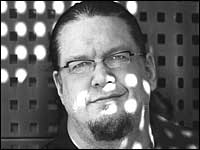
Penn Jillette from Penn & Teller is one of the most visible atheists in popular culture. He does an excellent job injecting a bit of skepticism into our daily lives via their TV show. He has also contributed a very good Essay in the NPR "This I Believe" Series. I've put his picture on the sidebar as the first of what I hope will be many famous free-thinkers, a designation that is not so trivial given that the overwhelming percentage of the world population claims belief in a deity of some sort.